

The Democratic Republic of Congo has prohibited exports of copper and cobalt concentrates, renewing a long-running effort to move more mineral processing inside the country. The restriction initially produced an outsized reaction in copper prices, despite evidence that concentrate represents only a limited share of Congo’s copper exports. For traders, the episode illustrates a deeper vulnerability: the global copper market has become highly responsive to even a potential interruption in raw-material flows.
The policy does not stop all Congolese copper exports. It targets concentrate, the partially processed material produced after mined ore is crushed and upgraded. Copper cathodes and other higher-value processed products are outside the stated concentrate prohibition. That distinction is essential because Congo already exports most of its copper as refined metal.
What Congo’s order says
The ministerial order was signed on June 29, 2026, by Congo’s ministers responsible for mines, foreign trade and the economy. Reuters first reported its contents on August 6 and subsequently updated its report on August 10. According to the document reviewed by Reuters, the concentrate prohibition took immediate effect.
The government presented the measure as a way to encourage mining companies to sell higher-value products rather than export less-processed material. The order also replaced a 2023 framework and introduced a separate tax regime for economically significant mining by-products, subject to a three-month transition period.
However, the restriction is not necessarily absolute. The mines minister can provide one-year waivers in strategic circumstances. The order did not publicly define those circumstances, leaving companies and market participants uncertain about how narrowly the exception will be applied.
This is not Congo’s first attempt to restrict concentrate exports. Similar bans were introduced in 2013, 2019 and 2023. Waivers were subsequently used when domestic smelting capacity could not absorb all the concentrate produced by local mines. The practical effect of the latest policy will therefore depend less on its headline language than on enforcement and the availability of exemptions.

Why the immediate physical impact may be limited
Official data cited by Reuters show that Congo exported 696,725 tonnes of copper cathodes during the first quarter of 2026. By comparison, it exported 53,926 tonnes of copper concentrate containing 18,863 tonnes of copper metal. These figures indicate that refined copper already dominates the country’s outbound copper trade.
That composition limits the volume directly exposed to the prohibition. It also explains why the measure should not be interpreted as a complete removal of Congolese copper from the international market. Cathode production can continue to reach overseas consumers, provided mines, processing plants, power systems and transport corridors remain operational.
The market nevertheless reacted rapidly when the policy became public. Reuters reported that benchmark three-month copper on the London Metal Exchange rose as much as 1.8% on August 6 to US$14,369.50 per metric tonne, its highest level since January 29. The LME cash price subsequently reached a record US$14,453.60 per tonne, according to a Reuters market commentary published on August 11.
Those observations describe the reaction around the announcement, not a current trading quotation. The LME identifies its Official Price as a global reference used in physical contracts, while live and historical market data may require licensed access. Prices can therefore move materially after the levels reported in this article.
Kamoa-Kakula shows the processing transition
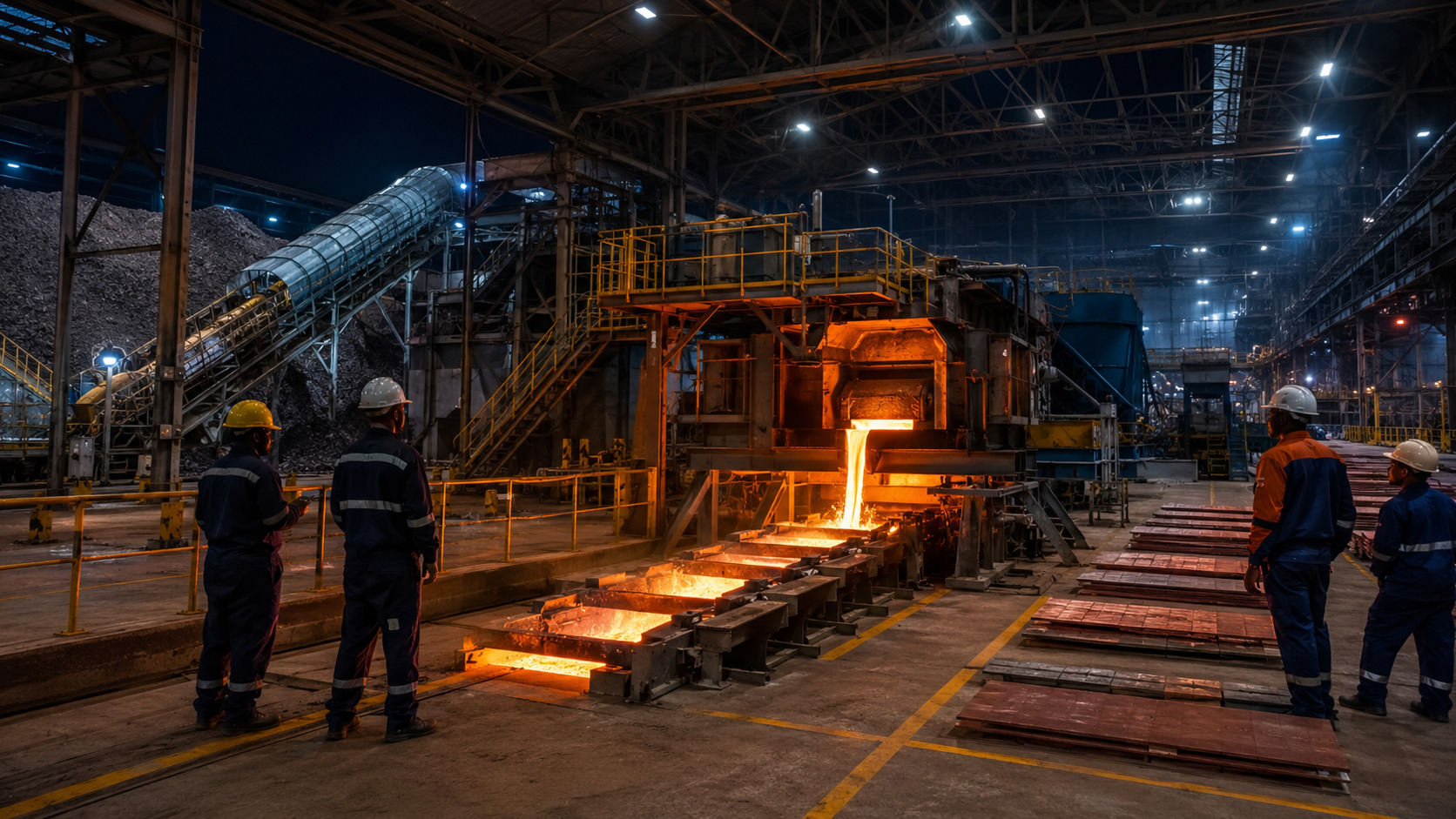
Kamoa-Kakula, operated through a partnership involving Ivanhoe Mines, Zijin Mining and the Congolese state, had previously received exemptions to export concentrate. Its newer processing infrastructure demonstrates how Congo wants the industry to change.
Ivanhoe reported on July 8, nearly one month before news of the latest order emerged, that Kamoa-Kakula’s concentrators produced 61,134 tonnes of copper in concentrate during the second quarter. Its on-site smelter produced 62,072 tonnes of copper anode, while the Lualaba Copper Smelter produced another 2,256 tonnes of copper in blister.
The company said its on-site smelter was targeting an annualized anode-production rate of approximately 300,000 tonnes during the second half of 2026, equivalent to about 60% of design capacity. Full capacity of 500,000 tonnes per year was expected in 2028. These are company targets rather than guaranteed outcomes and remain exposed to operating, feedstock, power and commissioning risks.
The weakness lies beyond the banned volume
The price response suggests that traders were reacting to the condition of the wider copper system, not only to the tonnes directly affected in Congo. Reuters reported on August 11 that LME copper inventories had declined from 401,000 tonnes in early May to 214,550 tonnes. It also reported that 58% of that remaining stock was represented by cancelled warrants, meaning the metal had been earmarked for potential removal from exchange warehouses.
In a well-supplied market, a limited concentrate restriction might be absorbed with little disruption. In a tighter system, uncertainty about any major producer can cause consumers, merchants and financial participants to reassess available supply. Congo’s importance as a major copper-producing country gives its policy decisions global significance even when the immediate restricted volume is comparatively small.
Another pressure point is smelting. Concentrate must be processed before it becomes usable refined metal. If domestic facilities cannot handle the available material and export waivers are withheld, concentrate could accumulate near mines while overseas smelters lose feedstock. This would create a mismatch: copper exists in the ground or in stockpiles, but it is not available in the form or location required by consumers.
Conversely, broad waivers and continued smelter ramp-ups could sharply reduce the disruption implied by the initial headline. Congo may still capture more domestic processing activity over time without producing an abrupt loss of refined supply.

What remains uncertain
- Waiver policy: The order permits strategic one-year exemptions but does not explain the eligibility test, timing or expected number of approvals.
- Enforcement: Previous restrictions were softened by waivers when processing capacity was insufficient. It is not yet clear whether enforcement will be stricter this time.
- Smelter performance: New capacity can reduce dependence on concentrate exports, but commissioning schedules and operating rates may change.
- Inventory conditions: Exchange stocks, cancelled warrants and regional availability can shift quickly, changing the market’s ability to absorb supply news.
- Price persistence: An announcement-driven price increase does not prove that a lasting physical shortage will follow.
Why the episode matters to traders
Beginner and intermediate traders should separate three layers of the story: the legal restriction, the physical volume affected and the market’s reaction. The legal language is broad, but the directly exposed copper-concentrate volume is much smaller than Congo’s refined-copper trade. The sharp price move therefore contains both a policy response and a premium for wider supply-chain uncertainty.
The next important evidence will come from waiver decisions, Congolese export data, production reports from major operators, smelter utilization and LME warehouse movements. These indicators can show whether the ban is changing physical flows or primarily accelerating a processing transition already under way.
Congo’s decision has not, by itself, established that the world is running out of copper. It has shown that the market’s buffer is perceived as thin enough for a restriction on one segment of one producer’s exports to generate immediate volatility. That sensitivity—not simply the banned tonnage—is the weak point exposed by the policy.
This article is for informational purposes only. It is not financial advice, a trading signal, a personalized recommendation or a forecast of returns.