

Litecoin’s long-running “digital silver” label is facing a fresh test in 2026. The network is still being used for low-cost transfers, merchant payments and optional confidential transactions, while a US-listed exchange-traded product has created a regulated route to price exposure. At the same time, stablecoins are taking a larger share of crypto payments and a serious Mimblewimble Extension Block, or MWEB, vulnerability forced emergency intervention by developers and miners.
That combination makes Litecoin more useful to examine through a price-to-utility lens than through branding alone. At the time of research on August 4, 2026, public market feeds placed LTC in the low-US$40s and its market capitalization near US$3.4 billion, although crypto prices vary by venue and can change within minutes. The central question is therefore not whether LTC is “cheap” in absolute terms, but whether its market value is supported by measurable, durable use.
Why the question has returned in 2026
Several events have pushed Litecoin’s utility back into focus. The Litecoin Foundation’s website currently reports more than 400 million cumulative transactions, average daily activity of roughly 300,000 transactions and an average fee below one US cent. Those figures are issuer-aligned claims rather than independently audited statistics, but they describe the network’s intended role: frequent, inexpensive transfers rather than a smart-contract economy.
The chronology matters. On December 16, 2025, MWEB’s balance reached a then-record 402,000 LTC, according to the Foundation’s year-end review published on December 31. On March 19, 2026, developers identified a critical MWEB validation flaw and confirmed that it had already been exploited. The detailed postmortem was published later, on April 28. Then, on May 28, a wallet update announcement added in-app gift-card purchasing alongside Tor and MWEB features, extending the network’s practical spending tools.
- October 27, 2025: the Canary Litecoin ETF began operating, according to its SEC filing.
- March 31, 2026: the fund reported holding 115,005 LTC worth about US$6.22 million.
- March–April 2026: the MWEB exploit and a later invalid-chain incident tested network governance, miner coordination and third-party infrastructure.
- May 28, 2026: Nexus Wallet announced native gift-card purchases using LTC.
What Price-to-Utility means
A 2023 research paper titled Bitcoin Gold, Litecoin Silver defined the Price-to-Utility, or PU, ratio as token price divided by estimated token utility. Its utility model combined token velocity, the share of older coins, supply dilution and price volatility. The authors also studied unspent outputs, spent outputs, weighted coin lifespan and Coin Days Destroyed to distinguish holding behavior from transactional use.
The paper’s terminology requires care. Its “staking ratio” refers to the share of coins with a lifespan above one year, not proof-of-stake consensus. Litecoin remains a proof-of-work network. More importantly, a current PU number cannot be calculated responsibly from a price quote and transaction count alone. The inputs must come from a consistent dataset and measurement window, while MWEB obscures some transaction details by design.
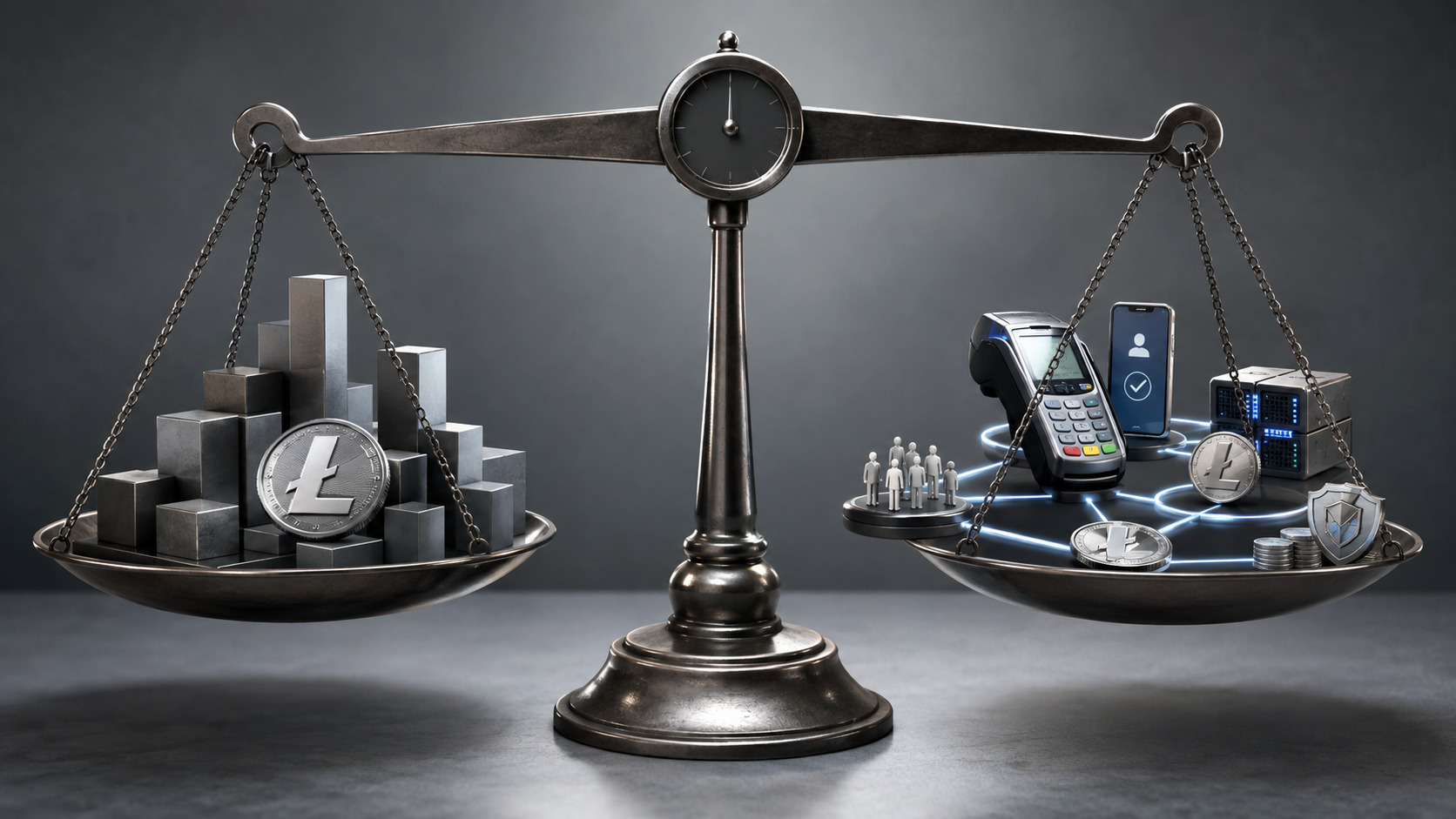
For news readers, a more defensible approach is to use PU as a dashboard rather than a single verdict. Price is the numerator. The utility denominator should consider transaction frequency, economic payment volume, merchant acceptance, fees, settlement reliability, privacy use, supply dilution and the diversity of real users. A rising price with stagnant or deteriorating utility would imply a richer valuation. Stable or falling price alongside broadening, reliable use could indicate improving utility support. Neither condition predicts future returns.
The utility case for Litecoin
Litecoin still has evidence of practical use. Its approximately 2.5-minute block target, 84 million maximum supply and current 6.25 LTC block reward preserve the basic design that positioned it as a faster transactional complement to Bitcoin. Low fees reduce friction for smaller transfers, remittances and merchant settlement, particularly when the alternative is paying a high fixed network fee.
Payment-processor data adds independent context but also shows the competitive pressure. BitPay’s review of 2025 ranked LTC fifth among coins and tokens by payment volume and the Litecoin network fourth among networks by volume. However, stablecoins accounted for 40% of BitPay’s payment volume, up from 30% in 2024. That matters because dollar-linked tokens compete directly for the everyday-payment use case while reducing the exchange-rate volatility faced by merchants and consumers.
MWEB provides a second utility layer. Its optional confidential transactions can conceal selected transaction details, giving users more cash-like privacy than the transparent base chain. The 402,000 LTC MWEB balance recorded in December 2025 suggested meaningful demand for that feature. The May 2026 Nexus Wallet update also attempted to connect LTC balances with spendable retail value through gift cards. Yet wallet features and balances do not reveal how many independent users are active or how much genuine commerce is occurring.
Institutional access is validation, not utility
The Canary Litecoin ETF offers evidence that LTC has moved beyond exchange-only access. Its SEC-filed report showed 470,000 shares outstanding and 115,005 LTC held at March 31, 2026, compared with 90,747 LTC at the end of 2025. The fund’s net assets were about US$6.22 million at quarter-end.
Those figures show a functioning regulated wrapper, but they should not be confused with payment adoption. An ETF can increase accessibility, custody convenience and market visibility without creating more on-chain transfers or merchant demand. In PU terms, institutional holdings can strengthen the price side of the equation while leaving the utility denominator unchanged.
Regulatory language is also relevant but limited. A 2026 CFTC rule listed Litecoin among examples of digital commodities connected to functional crypto systems. That classification supports the view that LTC has programmatic network use, but it does not certify the asset’s safety, fair value, future liquidity or suitability for any reader.
The MWEB incident changed the reliability calculation

The strongest challenge to the “digital silver” narrative came from the MWEB security incident. The April 28 postmortem said an attacker exploited a validation bug to create an inflated pegout of 85,034.47285734 LTC. Developers coordinated with miners to freeze the resulting outputs, contacted the actor and recovered the funds, apart from an agreed 850 LTC bounty that was later covered. The postmortem reported no confirmed user loss from the March event.
A second attempt in April exposed another failure mode. Upgraded nodes rejected the malicious block but some mining operations became stuck, while unupgraded miners extended an invalid chain by 13 blocks before it was reorganized out. The incident affected third-party services, including a reported 11,000 LTC swap through NEAR Intents and a smaller THORChain transaction. Litecoin Core 0.21.5.4 addressed the blocking issue.
Recovery demonstrated that developers and miners could act quickly, but it also revealed dependence on emergency coordination and uneven software adoption. For a payment network, reliability is part of utility. Transaction counts and low fees are less valuable when counterparties cannot confidently judge final settlement during an incident.
Is “digital silver” still a fair description?
The label remains defensible as a functional shorthand, but not as a valuation conclusion. Litecoin is still structured around a capped supply, proof-of-work security, inexpensive transfers and faster confirmation than Bitcoin. Its payment activity, processor presence, privacy option and new spending integrations support the idea of a more transactional companion to “digital gold.”
However, the analogy is weaker when it implies automatic scarcity value or a predictable relationship with Bitcoin. Litecoin competes not only with Bitcoin but with stablecoins, faster settlement networks, custodial payment apps and other low-fee blockchains. Its 2026 security incident also shows that mature age does not eliminate protocol and integration risk.
What remains unknown
A rigorous current PU calculation would require synchronized data for LTC velocity, economically adjusted transfer volume, old-coin share, realized volatility and annual dilution. Public transaction totals can include exchange movements, wallet consolidation, automated activity and privacy transactions that are difficult to classify. Merchant-processor statistics cover only their own platforms, while wallet announcements do not disclose complete user or spending data.
The most balanced conclusion as of August 4, 2026 is that Litecoin still possesses measurable utility, but the market does not provide enough transparent information to declare LTC definitively undervalued or overvalued through a single PU figure. “Digital silver” remains useful as a description of design intent and payment behavior. It should not be treated as proof of fair value, a price forecast or a substitute for assessing volatility, liquidity, regulatory change, software risk and competition.
This article is for informational purposes only. It is not financial advice, a trading signal, a personalized recommendation or a promise of returns.